Market shaping for global health has evolved over the past several decades into a critical component of access to medicines in low- and middle-income countries (LMICs).1 At its core, market shaping is an economic tool to correct a market shortcoming, deficiency, or distortion that compromises health outcomes.1 Among the market shaping best practices is the Healthy Market Framework (HMF), a structured tool—first created for vaccines in 2016 by Gavi, the Gates Foundation, and UNICEF—for assessing whether a market’s dynamics reliably enable access to essential health products.2 HMFs are one of the first key steps in designing coordinated market shaping interventions.3 This tool emerged where a small set of dominant actors was already investing at scale and needed a common framework to align strategies, coordinate interventions, and rationalize the deployment of significant capital.
HMFs and roadmaps for operationalizing them have contributed to market shaping success in markets characterized by centralized procurement, large and predictable donor financing, and a small number of global health actors capable of aggregating demand, absorbing risk, and sending clear signals to suppliers. What is less well understood is how these tools translate to markets that are fragmented across public and private buyers, dominated by out-of-pocket spending, and lacking a centralized financing architecture. Insulin is an instructive example of this kind of market.
The insulin market is characterized by a series of market shortcomings, including highly fragmented procurement, poor public-sector availability, supplier concentration, and information asymmetry between buyers and suppliers.4 Centralized procurement and substantial, predictable financing are foundational to Gavi’s market shaping approach and impact, but no equivalent mechanisms exist for insulin.5 Compounding this, while Gavi’s HMF was built on an assumption of substantial and predictable donor financing, NCDs receive just 2% of official development assistance for health, leaving countries reliant on domestic budgets and out-of-pocket payments.6 Furthermore, persistent gaps in insulin access make it a strong candidate for market shaping. Some 93 million adults in LMICs require insulin, but only 35 million can access it; even when available, it may be unaffordable.7–9 Recognizing this gap—and the absence of any existing actor or mechanism capable of filling it—the Insulin Healthy Markets Task Force (IHM-TF) was formed to convene partners around shared analysis, tools, technical expertise, and evidence to catalyze coordinated action. The IHM-TF seeks to understand whether market shaping can be made to work in the insulin market by developing an insulin HMF and operationalizing it into a time-bound Market Action Plan (MAP), a roadmap with prioritized actions, clear objectives, and defined stakeholder roles.
This paper presents the first HMF and MAP for the insulin market, potentially offering an approach for diagnosing and addressing market failures in a fragmented market context. Lessons learned by the IHM-TF in this effort can help country governments, civil society, and supply chain actors act on barriers to insulin access in their own contexts.
Diagnosing insulin market health
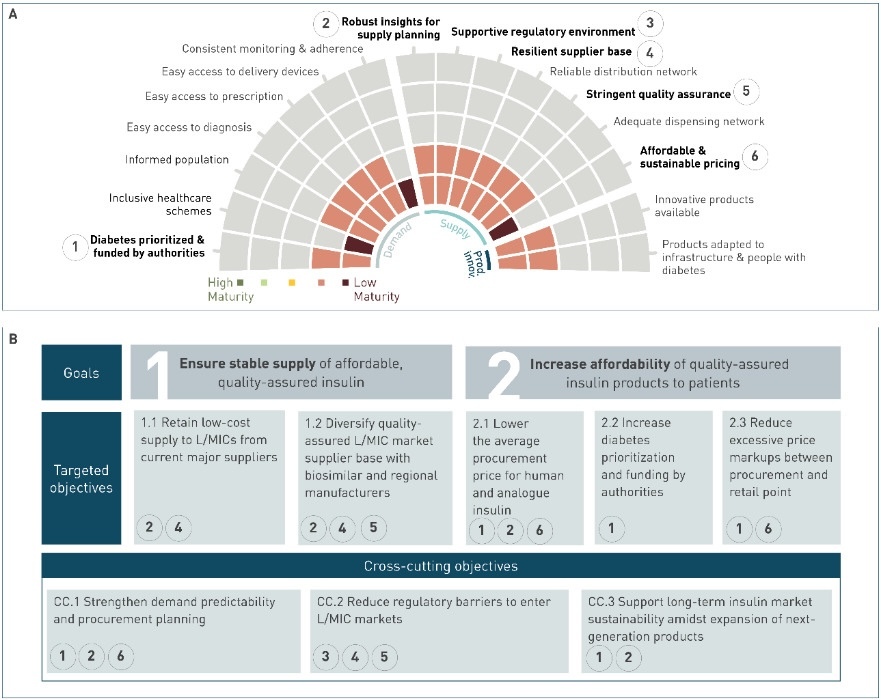
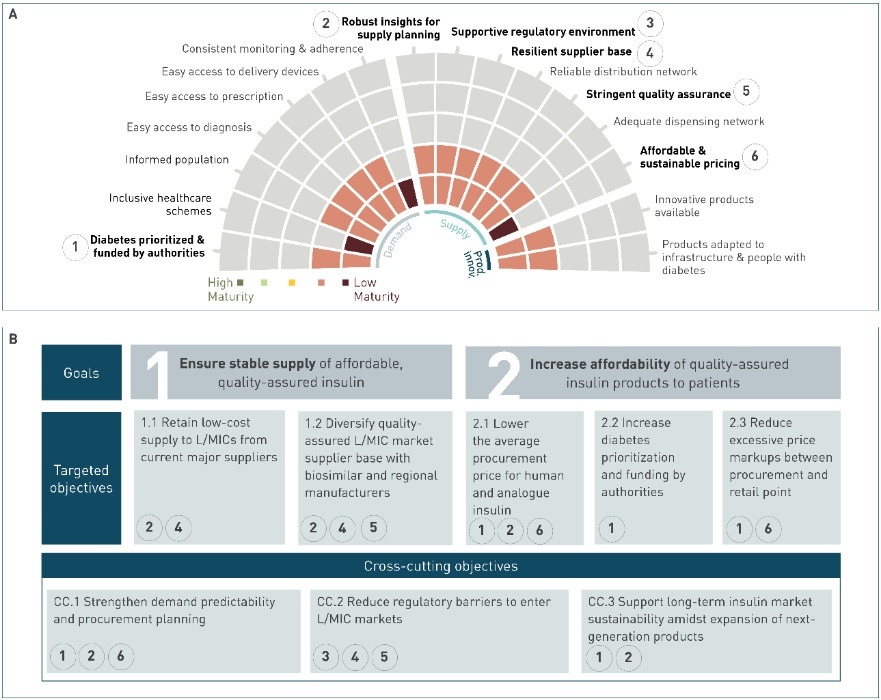
The IHM-TF assessed insulin market health in LMICs through a four-step process to characterize unmet need and assess the market conditions driving it. First, a patient cascade analysis was performed to characterize the insulin access gap that drew on diabetes prevalence estimates, insulin requirement rates, and diagnosis and treatment coverage. Second, literature on insulin access, availability, and barriers spanning market-level and patient/provider-level dynamics was reviewed alongside gray literature from global health organizations to identify market drivers of that gap. Third, more than 30 experts— selected based on recognized expertise within NCDs and market shaping, supplemented through referrals from initial contacts—iteratively refined these market drivers into 16 market elements, and scored the insulin market’s maturity on each element (Figure 1). Scoring used a structured tool designed to address the inherent subjective nature of expert scoring by grounding the effort in consistent and transparent criteria. The tool provided guiding questions to focus expert judgment, explicit descriptions of low and high maturity, metrics to inform rankings, and related data sources (these data are presented in Table S1 and S2 in the Online Supplementary Document). Finally, experts assigned criticality rankings to each market element in a priority-setting exercise to identify where limited resources and coordination effort would yield the greatest improvement in insulin access. The scores were averaged and reviewed in a group discussion in which experts examined the results, addressed points of disagreement, and adjusted their assessments where warranted. Following this discussion, six priority market elements were identified as root causes of market dysfunction or areas likely to ease other market constraints (Figure 1).
Charting a path forward
A three-step stakeholder engagement process moved this effort from market diagnosis to prioritized, coordinated action—drawing on insights from over 80 experts across 40 organizations (spanning country governments, multilateral agencies, civil society and advocacy organizations, academic institutions, funders, technical partners, and insulin manufacturers), three workshops, and more than 30 bilateral discussions. The first step of developing the MAP was to establish a shared foundation for action, which involved generating alignment on the need for a coordinated response to the gaps the HMF had identified and establishing a governance structure with defined roles and responsibilities. Second, a market analytics and intelligence evidence base was built that included insulin need projections, treatment gaps, market share trends, and key demand drivers. The third step was to translate that evidence base into a prioritized strategy for addressing insulin access barriers. Through these steps, the IHM-TF refined goals, objectives, and actions until the MAP represented the collective priorities, ongoing efforts, and organizational remits of the various members of the task force. This process resulted in a strategy comprising two primary goals supported by targeted and cross-cutting objectives with specific progress indicators, actions, and accountability metrics to support coordinated and efficient action (Figure 1, Table S3 in the Online Supplementary Document).
Implications for shaping fragmented markets
Developing an HMF and MAP for insulin required confronting several structural challenges that have no direct parallel in the vaccine and communicable disease contexts for which these tools were originally developed. Three lessons carry implications for funders, governments, and global health actors seeking to apply market shaping to fragmented market contexts.
1. Funders and global health actors should establish a neutral, technically capable coordinating body before market shaping efforts begin. Effective market shaping depends on such a body to align stakeholders and drive collective action, yet none existed for insulin. The IHM-TF was formed with a neutral secretariat to fill this gap. Shaping Equitable Market Access for Reproductive Health (SEMA) faced the same gap while developing an HMF for sexual and reproductive health (SRH) products, finding that a lack of central coordination can create duplicate or competing access initiatives that undermine market shaping efforts.10 Building credibility around this kind of body takes time; some stakeholders were initially skeptical of a task force with industry funding, and creating transparency around the HMF and MAP processes helped demonstrate the IHM-TF’s legitimacy.
2. Industry funding can help initiate action, provided it is paired with deliberate governance safeguards that reinforce a market shaping effort’s identity as global health led. Because the IHM-TF’s initial funding came from industry, the group established guardrails around industry’s level of engagement and visibility into the process, including by positioning industry in an advisory rather than decision-making role and creating two MAPs—one for global health actors and one shareable with industry partners. Industry was also engaged collectively on HMF and MAP development rather than individually and was excluded from sensitive conversations where its involvement could be perceived as shaping market priorities or outcomes. Securing a more appropriate institutional home and non-industry financing strengthened the IHM-TF’s ability to operate as a global health-led initiative. Transitioning the IHM-TF into a fully global health-funded effort is central to the next phase of work.
3. Establishing a trusted, neutral global health actor willing to invest in shared market data is key for increasing access to medicines. In the insulin market, much of the data needed were unavailable, inconsistently reported, or withheld due to commercial sensitivity. This mirrors SEMA’s challenges, where information gaps were similarly severe and asymmetric, and the ecosystem lacked a neutral player responsible for holding and managing data.10 Establishing a trusted, neutral repository for insulin market data remains a priority for the IHM-TF.
LOOKING AHEAD
The IHM-TF set out to understand whether market shaping best practices developed for centralized, donor-supported markets can be adapted to a fragmented and under-funded context like insulin. Among the key lessons learned: progress depends on building the coordinating infrastructure fragmented markets lack—a neutral convener, adequate and sustained financing, and shared market data. It also depends on sustaining a coalition around a shared purpose through articulating a clear vision, securing buy-in across all stakeholders, and consistently delivering value. The dynamics of fragmented markets vary widely in complexity, stakeholder ecosystems, and programmatic goals, so lessons from insulin cannot be assumed to hold in other fragmented markets. Regardless of market archetype, the HMF and MAP can offer funders, governments, and global health institutions a means to diagnose where market failures are most acute and to direct resources toward tackling barriers most likely to unlock broader market improvements.
This is increasingly urgent as the global health architecture shifts toward country ownership. HMF and MAP development can be replicated at the country level, and experience from other fragmented markets suggests it should be.10 This remains an important and ongoing aspect of this work. While global frameworks coordinate action on shared barriers that individual countries cannot address alone, country-level application of tools such as HMFs and MAPs can let national actors reassess market maturity against local conditions. For example, the insulin regulatory environment may be well-developed in one country yet remain a barrier in another—variation that a global score of “low maturity” masks. Together, coordinated global action and local application of these tools could offer a path toward closing the gap between the 93 million people in LMICs who need insulin and the 35 million who can access it.
Acknowledgements
We would like to thank Novo Nordisk A/S, whose original vision gave rise to the HMF effort, whose funding established it as a global public good, and who granted leadership autonomy to global health actors to take this effort forward. We would also like to thank Boston Consulting Group, which contributed significantly to developing the methodology, gathering the data, and conducting interviews related to the HMF. Other key global health decision-making members of the IHM-TF include Access Accelerated, Access to Medicine Foundation, Breakthrough T1D, Clinton Health Access Initiative, Coalition for Access to NCD Medicines and Products, Health Action International, Helmsley Charitable Trust, IFPMA, MedAccess, Medicines Patent Pool, NCD Alliance, PATH, University of Geneva, WHO, and World Diabetes Foundation. We also thank Sanofi for its contributions as industry members.
Funding
This work was funded by Novo Nordisk A/S.
Authorship contributions
MS and DP conceptualized the article. MS authored the first draft of the article and DP provided critical feedback. MS revised the draft and both authors reviewed and approved the final draft.
Disclosure of interest
The authors completed the ICMJE Disclosure of Interest Form (available upon request from the corresponding author) and declare the following activities and relationships: Both authors are employed by Linksbridge SPC, which received funding from Novo Nordisk A/S for the development of the insulin Market Action Plan and the preparation of this manuscript, and which serves as the secretariat of the Insulin Healthy Markets Task Force. Novo Nordisk A/S had no role in journal selection or manuscript drafting. The authors declare no other relationships or activities relevant to the present manuscript.
Additional material
This article contains additional information as an Online Supplementary Document.
Correspondence to
Mira Sytsma
Linksbridge SPC
808 5th Ave N, Seattle WA 98109
United States
mira.sytsma@linksbridge.com