Non-governmental organizations (NGOs) are central to delivering health services and strengthening health systems in conflict-affected and fragile settings, often filling gaps left by weakened state structures.1,2 Northern Myanmar exemplifies such a context: decades of armed conflicts between the Myanmar military and various Ethnic Armed Organizations (EAOs), coupled with political instability, poverty, and limited state capacity, have created a severe and persistent health crisis.3,4 This environment presents extreme volatility, uncertainty, complexity, and ambiguity (VUCA), testing the survival of any organization.5
Remarkably, some NGOs demonstrate exceptional longevity and adaptive capacity in these conditions. The British NGO Health Poverty Action (HPA) has operated in northern Myanmar for over 30 years, navigating military junta rule, a decade of political reform (2010–2020, albeit an uneven and contested process) , and a return to military rule post-2021 coup. While many international NGOs scaled down or withdrew following the 2021 coup and subsequent aid cuts, HPA sustained its operations. This prompts a critical question: what enables certain NGOs to develop resilience that allows them to withstand repeated environmental shocks and continue to function effectively?
The concept of ‘resilience’, originating in ecology and psychology, has gained traction in social sciences and governance studies.6,7 It refers to the capacity to absorb disturbance, adapt, and transform in the face of stress or adversity.8 In organizational studies, resilience is increasingly viewed not as a static trait but as a dynamic process involving continuous learning and adaptation.9,10 However, applied research on the resilience of international NGOs, particularly in protracted conflict zones, remains scarce. This study aims to address this gap by examining the sources and processes of HPA’s organizational resilience in northern Myanmar.
Methods
Study design and case selection
This research employs an in-depth qualitative case study methodology, suitable for exploring ‘how’ and ‘why’ questions within a real-world context.11 HPA was selected as a critical case 11 because it meets three conditions: (a) prolonged survival in an extreme environment (30+ years of continuous operation), (b) operation across multiple distinct political regimes (enabling within-case comparison), and (c) theoretical relevance—if organizational resilience is possible under such conditions, the mechanisms identified may be particularly revealing for theory-building. HPA is not claimed to be statistically representative of all NGOs in conflict zones; rather, it serves as a revelatory case for process-oriented resilience theory.
Data collection
Data were collected through multiple sources to ensure triangulation, as summarized in Table 1.
Documentary Analysis: We drew on internal HPA project reports, strategy documents, and publicly available materials (2014, 2019, 2021, 2022, 2023, 2024).
Longitudinal Observation: We tracked HPA’s activities and public communications from January 2021 to late 2025 via (a) monthly systematic review of press releases and social media, (b) attendance at 5 public lectures/seminars featuring HPA leadership, and (c) regular informal check-ins (every 3–4 months) with HPA partner organizations in China. No direct observation inside Myanmar was possible due to access restrictions and security concerns. We conducted field visits to HPA’s cooperative partners in Kunming and Puer cities, Yunan Province. We also conducted semi-structured interviews with other stakeholders based in Beijing, Shanghai (China) and Geneva (Switzerland).
Field Visits: We conducted site visits to HPA’s Kunming and Tengchong offices in China in July 2023 and November 2025.
Semi-structured Interviews & Lectures: We analyzed speeches and Questions & Answers sessions by HPA’s Chief Representative in China at academic institutions (e.g., China Foreign Affairs University, Peking University) between 2021-2025. Interviews were semi-structured using a guide focused on organizational history, key challenges, strategic decisions, and stakeholder relationships. Interviews lasted 45–90 minutes.
Secondary data from interviews conducted for related academic theses were also reviewed.12 This multi-method approach allowed for a comprehensive reconstruction of HPA’s strategic and operational evolution across different periods.
Data analysis
All interview recordings were transcribed verbatim. We conducted thematic analysis following Braun & Clarke’s six-phase framework: familiarization with data, initial coding, searching for themes, reviewing themes, defining themes, and writing. Initial coding was performed by JY, generating 47 distinct codes (e.g., “reading the political room,” “shifting from aid to systems,” “trust with EAOs,” “donor flexibility”). Codes were independently reviewed and grouped by FL into candidate themes. Disagreements were resolved through discussion with JZ. Through iterative refinement, three higher-order themes emerged: Cognition (organizational sensemaking and strategic positioning), Behavior (operational actions and resource allocation), and Relationship (network building and trust maintenance). These themes corresponded closely to the iterative adaptation processes observed across HPA’s history, leading to the development of the CBR model. The model was not imposed retrospectively; rather, it emerged inductively from the data and was then refined through comparison with existing resilience literature.
Analytical framework: the CBR process model
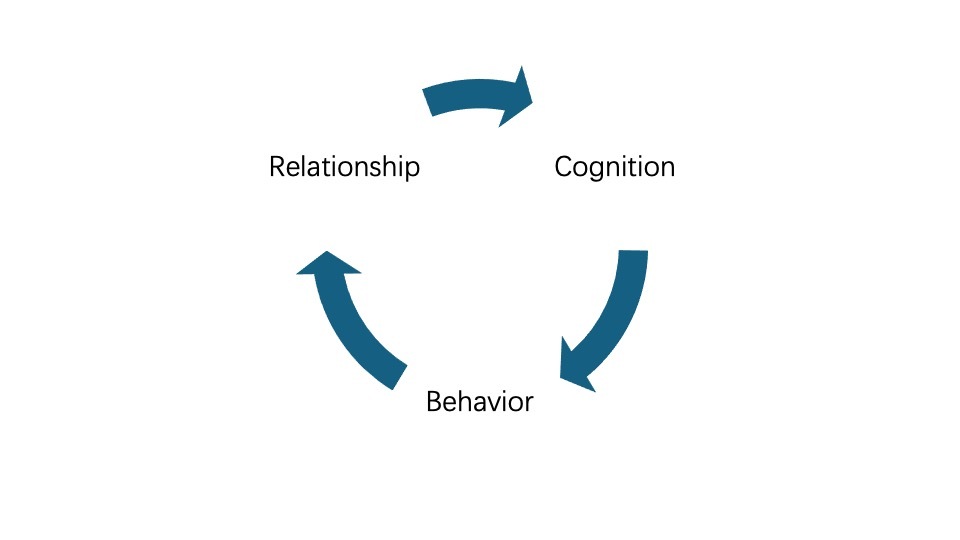
Moving beyond static views of resilience as a mere capacity, we developed a dynamic ‘Cognition-Behavior-Relationship (CBR)’ process model (Figure 1). The model posits that organizational resilience emerges from the iterative interaction of three core, intertwined elements.
The CBR model, developed for this analysis, differentiates from existing resilience frameworks: Process-oriented models of organizational resilience9,10 typically identify stages (anticipation, coping, adaptation) but do not specify the substantive domains in which adaptation must occur for NGOs in conflict zones. The CBR model advances this literature by proposing that for organizations operating where state authority is fragmented, legitimacy is contested, and access requires active negotiation, resilience emerges specifically from the iterative recalibration of three domains: (a) Cognition – how the organization reads risk, opportunity, and its own role; (b) Behavior – what it does operationally in response; and (c) Relationship – with whom it builds and maintains trust-based ties. These domains are hypothesized to be mutually reinforcing: updated cognition enables new behaviors, which in turn strengthen or weaken relationships, which then inform subsequent cognition.
_process_model_of_organizational_resilience.jpeg)
In this process, an organization faced with a stimulus (e.g., political coup, funding cut), engages its existing capabilities (C0, B0, R0). Through action and interaction, it produces an outcome, leading to an iterative upgrade of its capabilities (C1, B1, R1). This upgraded capability set then forms the basis for responding to the next challenge. The continuous nature of this process, and the effectiveness of each iteration, determines whether the organization merely survives, adapts, or grows.
Ethical considerations
The study relied primarily on publicly available information and observational data from open lectures. For the 12 semi-structured interviews, all participants received an information sheet explaining the study’s purpose and provided verbal informed consent prior to participation. Participants were assured of anonymity (no names or specific identifying roles are reported) and the right to withdraw at any time without consequence. No questions were asked about ongoing military operations, specific locations of armed group activities, or other potentially sensitive information that could compromise participant safety. Interview recordings and transcripts are stored on a password-protected university server accessible only to the research team. Where reference is made to internal documents or specific interviews from secondary sources, they are cited appropriately. The research was conducted as part of an academic inquiry with no direct intervention in HPA’s operations. Therefore, formal ethical approval was not required by our institutions for this non-interventional study using primarily public data.
Results
HPA’s 30-year journey in northern Myanmar is analyzed through the CBR model across three political periods. We acknowledge that the periodization below simplifies a complex political history; the “democratic transition” (2010–2020) was uneven, contested, and did not follow a linear trajectory.
Military rule period (1993-2009): establishing a foothold
Context: Myanmar was under Western sanctions. Northern areas, controlled by EAOs, were isolated from the state health system, with dire humanitarian needs and rampant infectious diseases like malaria.
Cognition: HPA positioned itself as a neutral, apolitical humanitarian actor. It recognized a convergence of interests: Western donors (e.g., UK) sought humanitarian outlets; China had an interest in border stability and preventing cross-border disease spread; EAO-controlled areas desperately needed health resources.
Behavior: HPA pioneered a ‘cross-border’ model, channeling international funds and Chinese technical expertise and resources from Yunnan province into EAO areas. Initial work focused on emergency humanitarian aid, refugee health, and basic malaria control. It later helped establish rudimentary health facilities and trained community health workers.
Relationship: HPA painstakingly built trust with EAO authorities. It acted as a crucial node, connecting EAO health departments, Yunnan health authorities, and international donors, such as the Global Fund. This network enabled the first structured health collaborations across the otherwise impermeable border.
Resilience Iteration: Moving from a purely humanitarian response, HPA iterated its model towards building local health capacity and facilitating cross-border health cooperation, thereby laying a foundation for future expansion.
Period of political reform (2010-2020) (2010-2020): expansion and system-building
Context: Myanmar opened politically and economically, leading to an influx of international aid and NGOs. The government sought engagement with EAO areas, though tensions persisted.
Cognition: HPA evolved its mandate from ‘humanitarian aid’ to a ‘humanitarian-development-peace nexus’. It saw an opportunity to use health as a politically low-sensitive entry point to bridge divides between the Union Government and EAOs, promoting integration and trust-building.
Behavior: HPA registered with the Union Government and signed a memorandum of Understanding (MOU) with the Ministry of Health. It tailored three distinct operational models for different EAO contexts, including a) supporting parallel EAO health systems while fostering indirect links to the state system, for example in Kachin; b) facilitating complementary division of labor between EAO and state systems, such as in Wa State; c) enhancing community uptake of state health services in integrated areas. It significantly increased local staff hiring to enable localization.
Relationship: HPA became a trusted broker, facilitating unprecedented dialogues and joint projects between Myanmar’s Ministry of Health and EAO health departments. It expanded partnerships with the United Nations agencies (UNICEF, UNFPA) and other international NGOs. It also successfully registered under China’s new NGO management law in 2017, solidifying its legal status there.
Resilience Iteration: HPA’s role transformed from a service provider to a system-builder and peace-broker. Its network became more complex and institutionalized, greatly enhancing its legitimacy and value to all sides.
State of emergency period (2021-2025): crisis navigation
Context: The 2021 military coup, renewed conflict, withdrawal of many Western donors, COVID-19 pandemic, and collapse of some state services created a perfect storm.
Cognition: HPA swiftly reprioritized, refocusing on emergency humanitarian response and core disease control (malaria, COVID-19) while striving to preserve earlier health system gains. It recognized the diminished space for peacebuilding but maintained a long-term view.
Behavior: HPA delivered rapid humanitarian assistance to new waves of internally displaced persons. It sustained malaria elimination programs and pivoted to support COVID-19 response, such as testing, and supporting vaccination campaigns and operating China-donated facilities. It continued training community health workers to maintain basic services. For example, when many donors withdrew in 2021–2022, HPA redirected its existing malaria surveillance infrastructure (originally funded by the Global Fund) to support COVID-19 contact tracing, maintaining operational capacity while addressing an emergent threat.
Relationship: HPA maintained its legal registration with the Myanmar authorities. It worked to preserve relationships with EAO authorities amidst active conflict. Crucially, it deepened engagement with Chinese academic, think tank, and health institutions, positioning itself as a key partner in China-Myanmar health cooperation.
Resilience Iteration: Faced with a severe regression in the operating environment, HPA demonstrated agile retrenchment to core life-saving activities while strategically investing in relationships, especially with China, deemed vital for future sustainability.
Synthesis of the CBR dynamic
Throughout these phases, HPA’s resilience stemmed from the continuous, iterative interplay of Cognition, Behavior, and Relationship:
Cognitive agility: HPA consistently viewed crises as containing opportunities. Its identity evolved from neutral aid provider to health system bridge-builder to crisis responder, always aligned with a realistic assessment of the political landscape. One HPA staff member interviewed described this as “reading the political room and then re-reading it every few months.”
Behavioral flexibility: HPA ‘acted according to the circumstance’. It adapted its operational models, staffing, and even financial rules to meet the needs of the moment, whether training village health volunteers, organizing high-level mediation meetings, or distributing emergency cash.
Relational sustenance: HPA consistently ‘sought win-win’ outcomes for stakeholders. It built trust by delivering tangible health benefits over decades, which allowed it to maintain access and credibility with conflicting parties even when geopolitical alignments shifted dramatically. An external donor representative noted: “They [HPA] were the only organization that could sit in a room with EAO health staff and Ministry of Health officials and get them to agree on a vaccination schedule. That trust wasn’t built in a year—it took fifteen.”
Discussion
This study demonstrates that organizational resilience for NGOs in conflict zones is a dynamic, self-reinforcing process rooted in continuous adaptation across cognitive, behavioral, and relational domains. The CBR model provides a framework for understanding how HPA navigated VUCA conditions.5
Theoretical implications
Our findings align with but extend process-oriented views of organizational resilience,9,10by specifying the substantive domains (Cognition, Behavior, Relationship) in which iterative learning and adaptation occur for NGOs in conflict settings. Where prior models have focused on stages of resilience (anticipation, coping, recovery), the CBR model identifies the content of adaptation—what exactly is being learned, changed, or reinforced. The HPA case shows that resilience is not just about bouncing back (recovery) but also bouncing forward (development).13 Each cycle of adaptation left the organization with enhanced capabilities. Furthermore, the study addresses a gap in the literature by applying resilience theory explicitly to international NGOs in conflict settings, a level of analysis often overlooked in favor of states or communities.7
The CBR model is presented as a middle-range conceptual framework—more structured than a simple thematic description but not claiming universal law-like status. Its intended use is as an analytic tool for case study research and comparative analysis across NGOs. Future research could test the model by (a) applying it to other conflict-affected settings (e.g., Syria, South Sudan, Sahel), (b) conducting comparative case studies of NGOs that failed to exhibit resilience, and (c) developing quantitative measures of cognition, behavior, and relationship variables across larger samples of NGOs.
Practical implications for global health
For NGOs: Success in fragile contexts requires more than technical excellence. It demands strategic sensibility (cognition), operational agility (behavior), and relentless investment in trust-based networks (relationship). Conscious investment in these three pillars is crucial for long-term sustainability.
For donors and policymakers: Supporting resilient health interventions requires flexible, long-term funding that allows NGOs to adapt and invest in relationship-building. Donors should value the ‘connective tissue’ and local legitimacy that organizations like HPA build over time, which is critical for service continuity during crises. The case also highlights the potential of ‘cross-border’ and ‘dual-track’ engagement models in situations of contested sovereignty.
For global health governance: The HPA case illustrates how a nimbler, networked NGO can sometimes achieve a form of ‘resilient health governance’ in areas where formal state-led governance is absent or contested.14 We define “resilient health governance” as the ability of a health system—even when fragmented across multiple authorities (state, EAO, NGO)—to maintain essential functions, adapt to shocks, and ensure service continuity through flexible, multi-actor coordination. This is distinct from service delivery: HPA contributed to governance not merely by providing clinical services, but by facilitating coordination protocols between the Ministry of Health and EAO health departments, establishing shared data systems, and creating referral pathways across conflict lines. This suggests a need to reconceptualize governance in fragile states as often hybrid and multi-actor.
Researcher positionality and potential bias
Three authors are affiliated with Chinese institutions (JY, FL) or have collaborations with Chinese partners (JZ). This institutional context may influence the analytical emphasis on China-related relationships, which feature prominently in HPA’s resilience story. We have taken several steps to mitigate potential bias: (a) triangulating HPA leadership narratives with interviews from non-China-based stakeholders (e.g., donor representatives in Geneva), (b) deliberately seeking out and reporting challenges in China-related partnerships (e.g., administrative delays in cross-border funding approvals), and (c) conducting negative case analysis—asking whether HPA would have survived without its China strategy and concluding that while China relationships were important, HPA’s pre-existing relationships with EAOs and its cognitive agility were equally critical. Nonetheless, readers should interpret findings regarding China’s role with awareness of author affiliations. The research was not commissioned or directed by any of the institutions mentioned, and all authors had full independence in analysis and writing.
Limitations
As a single, in-depth case study, the findings of HPA are not automatically generalizable. HPA’s unique positioning as a British NGO with a China-based, locally embedded management team may not be replicable. Furthermore, all field visits took place in China, not in northern Myanmar, due to access restrictions and security concerns. Consequently, our data on ground-level operations in EAO-controlled areas are derived primarily from interviews with HPA staff (who travel regularly across the border) and secondary reports, rather than direct observation. This may introduce reporting bias or miss nuances of local implementation. The study’s perspective is primarily organizational; we did not conduct community-level surveys or focus groups and therefore cannot fully assess the community-level impact or potential unintended consequences of HPA’s work. Public-facing materials (speeches, annual reports, lectures) inherently reflect organizational success narratives. To mitigate this bias, we triangulated these sources with internal reports (which occasionally documented setbacks, such as a funding shortfall in 2018 that led to staff reductions) and interviews with field staff not in leadership positions. Nonetheless, the study may underrepresent failures or near-failures in HPA’s history. Future research should compare multiple cases across different conflict settings to test and refine the CBR model.
Conclusions
The experience of HPA in northern Myanmar offers a powerful testament to the role of organizational resilience in sustaining global health action amidst conflicts. Resilience, as demonstrated, is a dynamic process forged through iterative cycles of cognitive recalibration, behavioral adaptation, and relational nurturing. For health NGOs aspiring to work in the world’s most challenging environments, cultivating these interconnected capacities is paramount. As conflicts worldwide continue to threaten health systems and gains made over past decades, understanding and fostering such organizational resilience becomes an urgent priority for the global health community.
Acknowledgement
We thank Prof. CHEN Zhirui, Prof. GUO Yan, Prof. SU Xiaoyou, for their guidance and support during the writing process of this manuscript.
Disclaimer
N/A.
Funding
supported by ‘the Fundamental Research Funds for the Central Universities’, China Foreign Affairs University, No. JY2024006).
Authorship contribution
YANG Jiayi conducted field research, collected and analyzed materials, and drafted the Chinese manuscript. LI Fujian proposed the analytical framework and revised the Chinese manuscript. ZHAO Jinkou contributed research ideas and drafted and refined the English manuscript.
Disclosure of interest
The authors completed the ICMJE Disclosure of Interest Form and disclose no relevant interests.
Correspondence to:
ZHAO Jinkou, Institute of Global Health, University of Geneva, Genva Switzerland and Fudan Institute of Advanced Studies in Global Health, Fudan University, Shanghai, China. Jinkou.zhao@unige.ch