Despite the now widely acknowledged impacts of climate change and the large body of research that has gone into its study, climate change’s effect on women’s health remains an underexplored area in quantitative scientific research. With climate change, we are seeing an increase in the frequency of climate shocks, such as droughts, storms, and extreme temperatures,1 as well as climate-related events such as landslides and volcanoes.2 These changes and shocks disproportionately affect women3 and low- and middle-income countries (LMICs),4 causing a decrease in agricultural success5 and a rise in intimate partner violence (IPV).6
Intimate partner violence (IPV) is one of the most ubiquitous and pressing concerns for global health, with 27% of women globally and 37% of women in LMICs experiencing IPV at least once in their lifetime.7,8 Recent research has also begun to focus on the relationship between climate change and IPV, indicating wide variation between countries and a broad consensus that countries that have experienced recent climate shocks are more likely to have higher prevalence of IPV.9,10 For example, heatwaves have been found to be positively associated with IPV.11 Droughts, as well, have been linked to IPV in countries with lower incomes.12 Although researchers have yet to offer a definitive explanation for the association between climate shocks and IPV, many point to agricultural success and women’s obligation to deal with household food insecurity as key predictors of IPV levels.13,14
Although not typically considered a direct result of climate change, landslides also serve as a key climate indicator, worsened by drought and extreme temperatures via decreased vegetation, and rapid floods or storms.2,15 In addition, landslides have significant economic consequences for agricultural output and property damage, and therefore may serve as an important measure of climate change’s impact on household instability or food insecurity. This study is among the first to focus specifically on landslides as a predictor of IPV.
This study investigates how climate hazards, and landslides specifically, are associated with IPV and explores the broader implications of these findings for future research and understanding of IPV risk as climate change worsens. Drawing on nationally representative data from 156 different countries, this study aims to expand the body of research on women’s health in climate science and provide quantitative evidence across countries. By incorporating additional control variables such as gender inequality and economic dependence on agriculture, I account for the influence of key socioeconomic factors that shape the effect of climate change on IPV. Overall, the primary objective of this study is to contribute to understanding the climate-gender nexus by exploring the influence of climate shocks on IPV and bringing additional quantitative analysis to the discussion of the effect of climate change on human health using data spanning 1993 to 2019.
METHODS
Data
This study utilized IPV data from 156 countries compiled by Mannell et al. (2024).16 IPV was defined as emotional, physical, or sexual violence by any husband/intimate partner within the last 12 months. Using the compiled data from Mannell et al. (2024), this study measured IPV using country-level prevalence estimates from 363 nationally representative surveys, including: Demographic and Health Surveys (DHS); Multiple Indicator Cluster Surveys (MICS); Reproductive Health Surveys; United Nations Multi-country study on Women’s Health and Domestic Violence against Women; United Nations Multi-Country study of Men and Violence; International Violence Against Women Surveys, two databases (World Health Organization (WHO) 2018 estimates on violence against women, the UN Women Global Database on Violence against Women) and one report (Pan American Health Organization’s 2018 publication on Intimate Partner Violence against Women in the Americas). A full list of IPV sources is provided in the S1 Table of Mannell et al. (2024).16
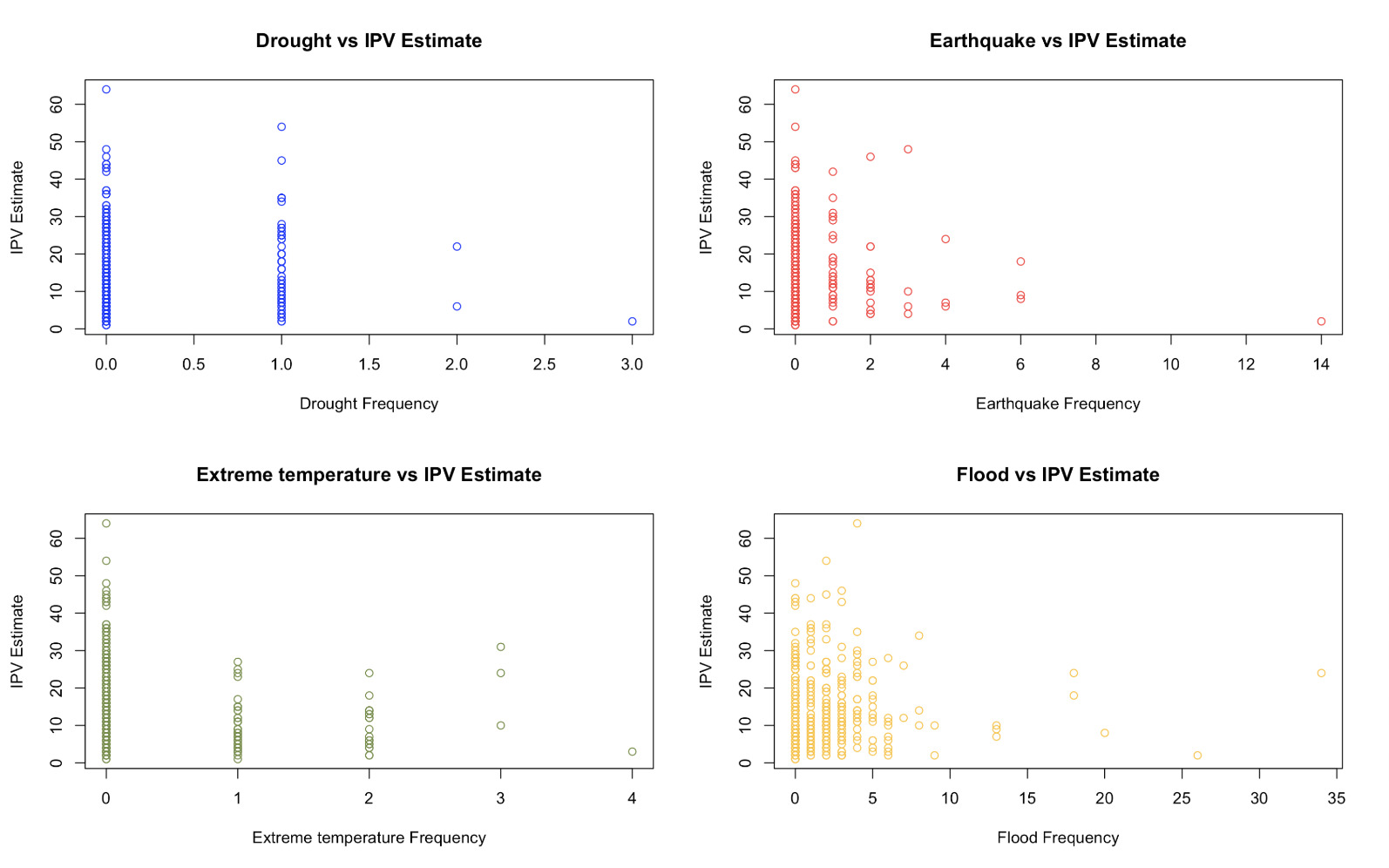
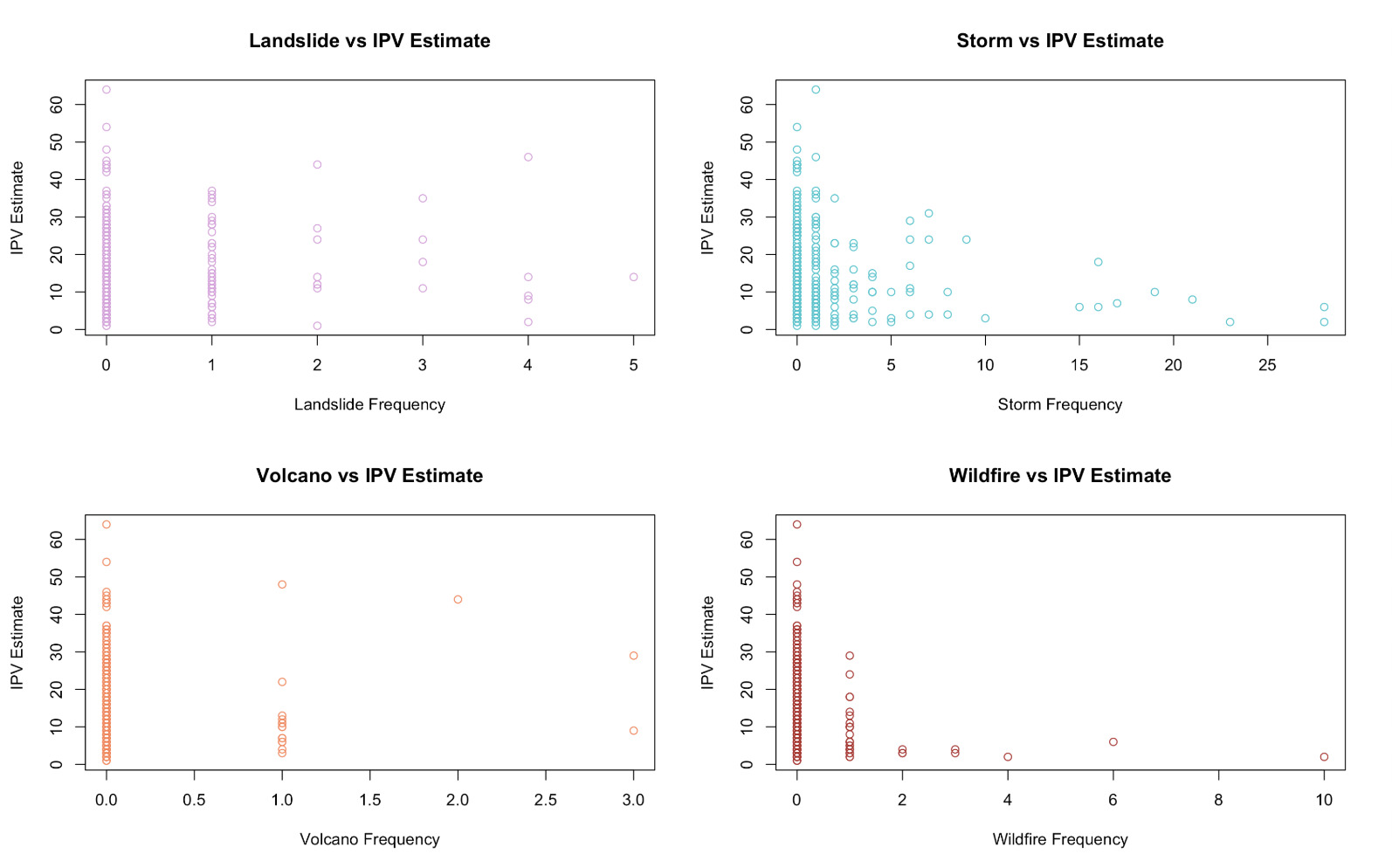
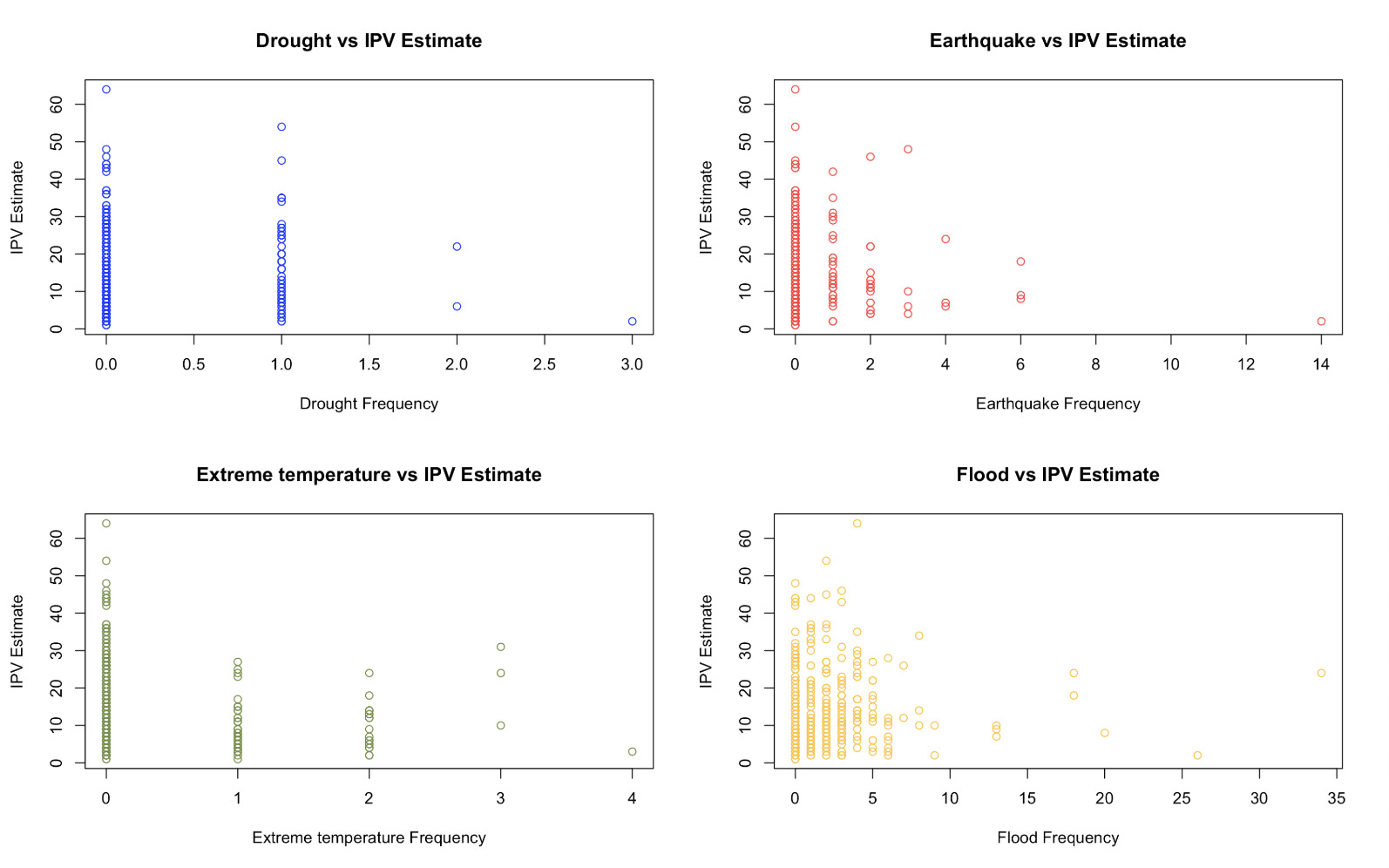
To assess the relationship between climate disasters and IPV, this study’s models incorporated climate shock counts compiled in the Mannell et al. (2024) dataset,16 which were counted through the Emergency Events Database (EM DAT) by the Centre for Research on the Epidemiology of Disasters (CRED). Climate shocks were defined as natural, technological, and complex emergency events where there were 10 or more deaths, 100 or more people were affected/injured/homeless, or a declaration by the country was made of a state of emergency and/or an appeal for international assistance. For inclusion in this study, I used the eight climate shock indicators that Mannell et al. (2024) used: earthquakes, volcanoes, landslides, extreme temperatures, droughts, floods, storms, and wildfires (Fig. 1).
__al.png)
In the final model, World Bank data on GDP per capita and UN Gender Inequality Index data were incorporated as country-level control variables, and World Bank data on agriculture, forestry, and fishing as a percentage of GDP (Ag_GDP) was interacted with climate shocks. The control variables were included to account for the impact of economic growth on IPV rates and baseline levels of gender inequality that impact IPV, while the reliance of a country’s economy on agriculture was included to help understand the mechanism through which climate shocks affect IPV, with the understanding that climate shocks are typically associated with lowered agricultural outputs.
The World Bank GDP data, published by the International Comparison Program (ICP) and the Eurostat PPP Program, provided country-level data on gross domestic product (GDP) per capita from 1990 to 2024, measured as purchasing power parity (PPP) based on the current international dollar. The World Bank Group also provided data on Ag_GDP from 1960 to 2024, using country official statistics from National Statistical Organizations and/or Central Banks. To incorporate GDP and Ag_GDP for each country-year, the World Bank datasets were reshaped from wide to long format and then left-joined to country-years with available IPV and climate shock variables. To create a better fit, the GDP data were log-transformed to account for a skewed distribution.
The third control variable used the Gender Inequality Index (GII) from the UN Human Development Reports, defined as a composite metric using reproductive health, empowerment, and the labor market to measure gender inequality. This variable helps account for gender-related cross-national differences in culture, public policy, and outcomes. A lower GII value indicates lower gender inequality, and vice versa. For this metric, GII values were matched for each specific country and year, to account for the substantial changes in gender inequality over time.
For missing data, I substituted the nearest country-year value, within 5 years if one was available. If none was available, the observation was dropped from the study.
Using compiled data from Mannell et al. (2024) and my selected control variables, the model produced a dataset including an IPV estimate, counts for the eight climate shocks, and GDP for a single year in a given country. Each country-year was included as a separate row, with between 1 and 13 years of data available per country, leading to a total of 363 country-year data points over 21 years from 1993 to 2019 and 156 countries.
Analysis
To model the influence of climate shocks and the control variables on the outcome variable, IPV, this study ran two-way fixed effects Ordinary Least Squares (OLS) regression model. For this study, an OLS regression was well-suited for examining the effect of several predictors, control variables, and constants. The model was fit on climate shocks interacted with Ag_GDP, and GII and log-transformed GDP as controls to predict IPV, in addition to year and subregion fixed effects. Year and subregions (as classified under the UN M49 standard system), were included as fixed effects in the model to account for systematic differences across regions that may influence IPV, such as cultural norms and migration patterns. This model, therefore, allowed us to assess the role of climate, economic, and social factors on IPV estimates while adjusting for skewed distributions or weighted effects. The quality of model fit was assessed using various metrics, including R2, p-values, and residual standard error. Standard errors were clustered at the country level to understand country-specific effects and assess for variance across datapoints within each country.
RESULTS
The final model included eight climate shocks as the independent variables of interest (Drought, Earthquake, Extreme temperature, Flood, Landslide, Storm, Volcano, Wildfire), two control variables (GDP, GII), subregion and year fixed effects, and Ag_GDP as an interaction variable. Table 1 summarizes the results of my preliminary model, without Ag_GDP interacting with climate shocks. Table 2 summarizes the results of the final two-way fixed effects model. Column 1 of Table 2 displays the model with subregion fixed effects and no controls; Column 2 adds year fixed effects; and Column 3 represents the final model, including both subregion and year fixed effects, as well as GII and log-transformed GDP as controls. Residual analysis of the final model indicated a median residual of -0.247, a maximum of 38.329, and a minimum of -22.789.
Five observations were identified as outliers (studentized residuals > ±3), including the Democratic Republic of the Congo 2007 and Ethiopia 2003.
Landslides are a significant predictor of IPV
Among the climate shocks in the final model, landslides, in interaction with Ag_GDP, were the only significant predictor of IPV incidence, with a positive association (β = 0.136, p = 0.0424). Additionally, they remained at least significant to the 0.10 level across all models, including the preliminary model without interaction with Ag_GDP, indicating a robust and consistent positive relationship. Although the other climate shocks were not statistically significant in this model, variation in climate data, IPV estimates, and potential time-lag effects may have impacted results, suggesting that other climate shocks may still be significant in other studies.
GII is strongly positively associated with IPV
Notably, this study also found GII to be strongly positively associated with IPV, indicating that higher levels of gender inequality, based on factors such as share of seats in parliament or labor force participation rate, are linked to higher IPV incidence (β = 22.876, p = 0.00016).
Additionally, Droughts (β = 0.036, p = 0.725), Extreme Temperatures (β = 0.0217, p = 0.781), and Earthquakes (β = 0.02, p = 0.631) were found to have a positive association with IPV, but were not statistically significant using a p-value of 0.05.
DISCUSSION
This paper is among the first to focus specifically on landslides’ impact on rates of IPV, suggesting that landslides are a more direct predictor of IPV, as opposed to floods. Of the selected climate shocks, landslides were the only climate shock found to be significant, though not typically included in studies or examined specifically (β = 0.136, p = 0.0424). This result corroborates the finding from Mannell et al. (2024),16 in which landslides were analyzed within the aggregated category of hydro-meteorological climate factors comprising storms, landslides, and floods.
Although this category tends to focus on the effects of floods, these results indicate that landslides may also be a key climate shock for predicting IPV. Studies typically do not focus on the effect of landslides, but landslides may be a better index for the impact severity of climate change. In my preliminary model, landslides were a significant predictor of IPV incidence (p = 0.0984), and its increased significance when in interaction with Ag_GDP (p = 0.0424) indicates the mechanism through which landslides affect IPV occurs through its effect on agricultural production. Landslides arguably have greater material consequences for agricultural output, household income, and property damage and, as a result, may be a better measure for climate change’s impact on household instability. Sim et al. (2023) demonstrate the growing economic consequences of landslides in the twenty-first century, specifically as a consequence of climate change in the developing world, resulting in nearly $20 billion annually.17
Landslides, furthermore, may have economic consequences due to disruption of ground transportation to local food markets.18 Nino suggests that blockage of roads used in supply chain networks due to landslides may raise local wholesale food prices 0.5–0.9% within a week, while increasing prices by about 0.4% in markets where affected food is diverted to.18
Additionally, it is possible that when the impact of floods may be variable depending on the severity of the flood itself, landslides may be indicative of the scale and cascade effects on IPV-determinants, such as agricultural production. Global projections of landslides remain poorly understood, but analyses by Duan et al. (2025) suggest that, under SSP5-8.5, nearly 4.63 billion people could experience significant increases in landslide susceptibility, notably in Middle Eastern Africa, India, and the northeastern United States.19
Of the control variables, GII demonstrated the strongest influence and greatest significance (β = 22.876, p = 0.00016). Despite extensive evidence linking climate change to increased gender inequality20 and gender inequality to IPV,21 GII is typically not included as a variable in analyses of climate-related drivers of IPV. However, this finding highlights the central role of gender inequality at the national level in shaping IPV prevalence and accounts for baseline levels in IPV estimates before analysis of the impacts of climate shocks. Studies omitting this key variable may overlook the impact of existing gender norms, institutional buffers, and women’s access to resources, for example, on the extent to which climate shocks translate to heightened IPV risk. To account for the influence of societal factors and baseline levels of gender inequality in countries, GII should be included in future studies.
Notably, despite the large body of papers, including Guo et al. (2025)22 and Clemens et al. (1999),23 finding floods to be a significant predictor of IPV, this study found floods, when interacting with Ag_GDP, to be not only statistically insignificant (p = 0.883), but also associated with a negative and relatively small estimate (β = -0.0018). This result indicates that even if floods were a significant predictor, each event would contribute to a minimal decrease in IPV incidence, of a magnitude of only 0.0018. However, differences between studies in factors including climate data collection, IPV estimates, and potential time-lag effects lead us to suggest that climate shocks not found to be significant in my study may still be significant in other studies.
Storms, although also not significant, were consistently associated with a negative estimate across all models (β = -0.0103 in the final). This result, were it to be significant, would be interpreted such that an increase in storms decreases IPV in countries with greater agricultural economic dependence. When considered alongside the findings from Dehingia et al. (2024)24 and Aguilar-Gómez & Salazar-Díaz (2025)25 that link droughts to IPV, storms, when occurring in drought-prone areas, may be beneficial in some aspects. Conceptually, a significant finding of this result in other studies may have implications for the success of agriculture and domestic violence; the presence of storms may increase agricultural production, which, as Ragetlie et al. (2021) found,13 is inversely related to domestic violence and IPV. Additionally, it may be that storms demonstrate a nonlinear U-shaped relationship, where moderate levels of storms are associated with low IPV incidence and both low and high extremes are associated with high IPV incidence.
It would be useful in future work to run a similar analysis with lagged data to determine the delayed effects of climate shocks on IPV. The influence of climate shocks on IPV may be delayed such that future investigation of a lagged effect could reveal even more about the relationship discussed here. In this study, limited availability of data and an insufficient number of lagged data points to associate with variables precluded running a meaningful lagged analysis. With more robust data, it would also be useful to study this relationship with a longitudinal design, investigating the relationship over time, in addition to the cross-sectional design in this study. Availability of climate shock data also limited analysis with more granular data. In future studies, it may be useful to incorporate more include climate shock variables including severity, geographic spread, and population exposure to more accurately reflect risk for populations of interest. Finally, due to a shared data source, as Mannell et al. (2024),16 the IPV variable of past 12-month physical and/or sexual violence, although chosen for its best coverage, does not account for other types of violence and does not allow for more specific analysis of climate shocks on different types of IPV.
Acknowledgements
Many thanks to Tristan Ballard and Joanna Shepherd for their guidance on this project and comments on an earlier draft, and to Jenevieve Mannell for making available datasets on EM-DAT climate shocks and IPV.
Funding
No funding was received for this study
Authorship contributions
KK conceptualized the study, was involved in the data analysis, the literature review, and wrote the all drafts of the manuscript, including review and editing of the final manuscript.
Disclosure of interest
The author completed the ICMJE Disclosure of Interest Form (available upon request from the author) and discloses no relevant interests
Correspondence to:
Kate Kang
25 Woodley Rd, Winnetka, IL, United States.
kate.e.kang@gmail.com